
It's About Time
"Time flies like an arrow. Fruit flies like a banana."

I first heard the above quotation from Noble Laureate physicist Brian Josephson at one of the early SEED dialogues. It’s a funny play on words, but untrue. Time does not fly like an arrow; it’s about time we change our perspective on that. Time is not actually a line, nor is it only units on a clock; it is an infinitely deep and mysterious subject comparable to the ocean. We measure the ocean in fathoms, units of about six feet wide, as if we were trying to get our arms around something but couldn’t quite do it. The depth of the ocean was once thought of as unfathomable; the same could be said about time, or for that matter, love.

We have reduced time to a narrow aspect of its totality, and then convinced ourselves this was the only view of time that was intuitive and wholly correct. We did this through a form of self-indoctrination that has been passed along to future generations. The West has been the biggest colonizer in the world, but we first had to colonize our own minds into believing that what we think is the truth. It isn’t—–or it isn’t all of the truth anyway. The Western view of time is only one way to see the world. Every worldview has advantages and disadvantages, opening up one doorway while closing another.
If you think about it, different views of time are the biggest conflict in any effort at colonization. The British desperately tried in vain to get the natives of India to see time the way they did. The same thing happened in America during colonization with Native and African-Americans. Why? Because Native and African views of time are closely linked to natural rhythms. Now, you might ask: Isn’t linear time also derived from the rhythms of nature? Yes and no. It may have been at its origins, but the way we think of time now is at least one or two steps removed from natural cycles, if not altogether removed.
The moon is a natural way to tell time. The moon is the same, but ever changing. The earliest calendars were lunar, because the earliest concepts of time began with the moon and its connection to women’s bodies. While researching Original Love, I discovered that the word ritual originates from the Sanskrit word rtü, meaning menses. This blew my mind when I learned of this, for it indicates to me that the very first rituals were centered on the feminine experience. Since women’s menstrual cycles were in synchronization with the phases of the moon, women were likely the first time keepers. And since wisdom naturally emerges from awareness of nature and its iterative cycles, women gravitated to becoming the wisdom keepers and long-term strategic planners for the tribe. Men became the protectors, hunters, and active agents of change in the short term, guided by the women’s vision. This was a successful way of pairing the sacred feminine with the sacred masculine.
Another ancient way of telling time was with astrolabes and sundials, which were also directly connected with natural rhythms. But with the advent of clocks we moved one step away from natural rhythms, even as analog clocks still moved in the same direction as the sun. It was likely during the Renaissance we stopped referring to things moving “sunwise” and began to say they moved clockwise. (I don’t know about you, but I don’t know many wise clocks. Maybe some grandfather clocks).
With the coming of modern digital clocks, we entirely divorced ourselves from associating time with natural cycles. In my view, this is the root of all modern problems, which is why I write so much on the subject of time. Time has become wholly abstract. People now rush around trying to complete tasks based on the clock rather than how they feel or what nature is doing. We have put ourselves at odds with the natural world, which is now less real to us than clock time. Moving in synchronization with nature is healing because we are nature; we are the light, air, water, and earth. Moving against the tide, on the other hand, is markedly unhealthy. At the root of all our modern problems is a time-sickness. The way back to wellness is through readjusting ourselves to following nature rather than relentlessly seeking to overcome her.
Why is linear consciousness so persistent? Is it because it is true? Or is it simply because we have become accustomed to it, and we don’t know how to exist any other way. Einstein himself, upon learning of the death of his dear friend, the Swiss engineer, Michele
Besso, wrote: “Now he has departed from this world a little ahead of me. This signifies nothing. For us believing physicists, the distinction between past, present, and future is only a stubbornly persistent illusion.” To Einstein, linear time is an illusion, but one that is hard to change.
Many people thought relativity and quantum theory would change the way we think of time. But it has yet to shift mainstream beliefs. The idea of events happening in the past and then being over is still prevalent. The same is true of the future, which is considered something we want to change and control, but not something that is actively affecting the present.
Time freedom (independence from the idea that time moves in a line from past to present to future) is the direction we are heading toward, but have not yet fully embraced. Many have spoken of it, including the Swiss/German philosopher Jean Gebser. William Faulkner famously said “The past is never dead. In fact, it isn’t even past…” to indicate how what we call the past is still here. Quantum physics thinks the same way. “Energy cannot be created or destroyed,” said Einstein. And that makes sense, for a vibration, once it occurs, can never end; it only goes into the subtle realm. But what about the future? Is it not pulling us forward surreptitiously, like the wind pulls a sail? Is the future not asserting an effect on present action much like the events we consider to be past?
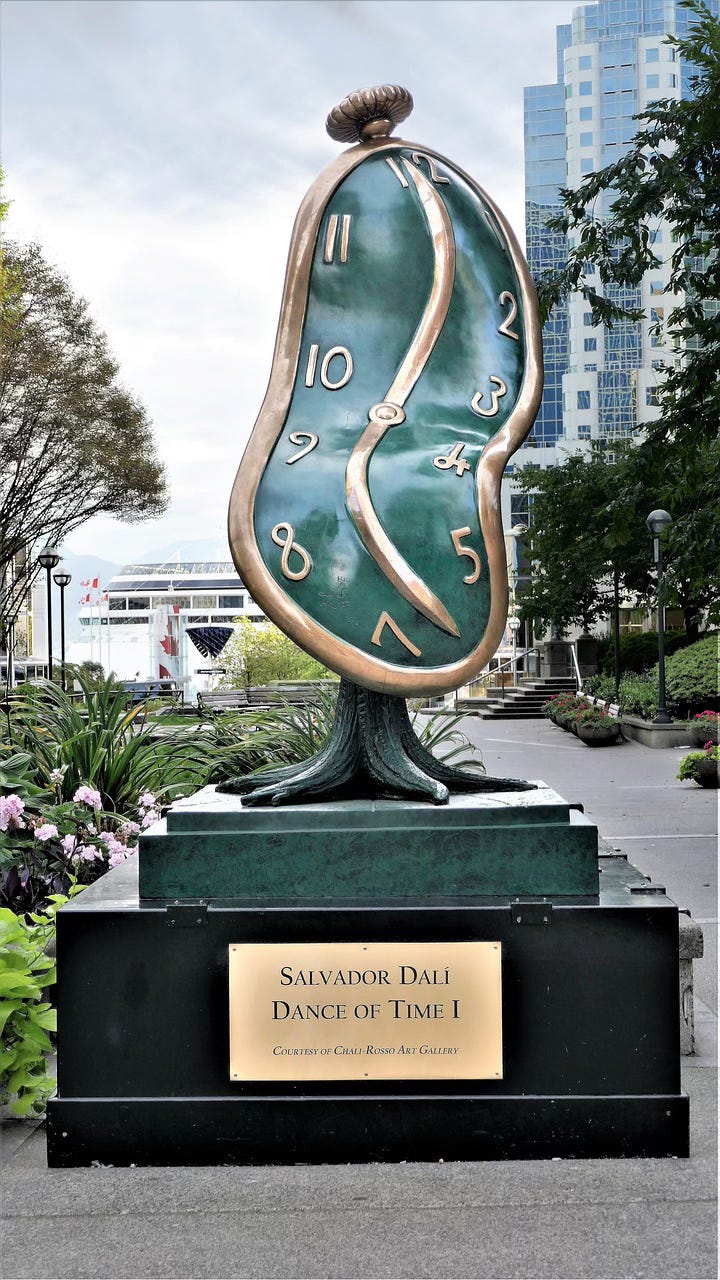
There are many ways to look at time. My friend Cynthia Sue Larson does fascinating research on the “Mandela effect,” where people remember past events differently, indicating that even the past is more pliable than we realize. I am also encouraged to notice the plethora of films and novels dealing with time travel. I can feel the way we look at time softening up, like the melting clock in Salvador Dali’s painting. I believe the human mind is being prepared to radically open up our thinking about time, welcoming in a time-free future that will also open up our hearts. Love is timeless. It has always been here and will always be here. Earlier, I wrote about time and compared it to the ocean, as unfathomable. The same thing can be said about love. It is timeless and deep beyond any recognition.
Glenn, fascinating about "ritual". And also reflective of linear thinking and society, as i put in one of my books: the root, "reg- “move in a straight line,” ... linear thinking and alphabetic movable types ruled by Reichs, the German word for “empire,” meaning “kingdom, realm, state,” also, “riches” and known more colloquially as “the ruling class.” The root of “rule” is “reg-, move or direct in a straight line, rule.” And i agree with your overall examples, tho call attention to: "We did this through a form of self-indoctrination that has been passed along to future generations."... i think this overlooks the Doctrine of Christian Discovery, Domination and Dehumanization (Steven Newcomb (Shawnee-Lenape) writes and speaks of that often) that was brought to Turtle Island and violently imposed on the Natives, and still affects the US legal system as well as Peoples around the world.